

Anodizing
- Achieves a diverse range of colors, from rich dark tones to vibrant vivid colors
- Suitable for both indoor and outdoor use, offering excellent weather and corrosion resistance (against UV rays, acid rain, and salt damage)
When exposed to air, aluminum forms a thin oxide film. However, this naturally formed film is extremely thin, leaving the metal susceptible to corrosion depending on the operating environment. Applying an alumite finish imparts properties such as corrosion resistance, wear resistance, and electrical insulation.
- An oxide film formed on an aluminum surface by electrolysis.
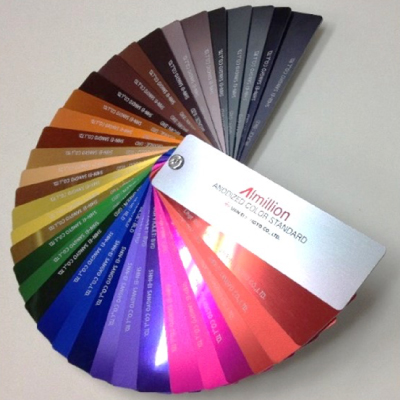
- It is possible to impart any desired color by soaking the porous material in an organic dye.
With "Almillion," we can achieve colors that other companies cannot—just like a color sample.
Principles of Anodizing
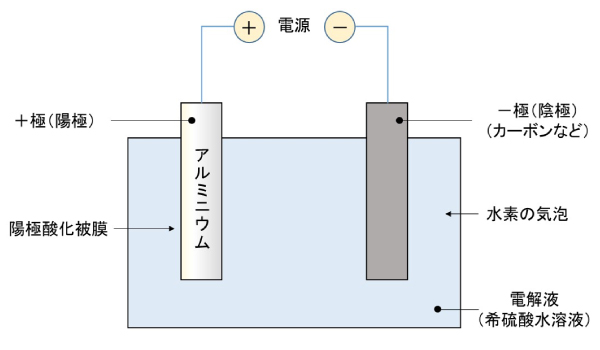
Regarding the principle of the anodizing process, an electric current is passed through a dilute sulfuric acid electrolyte; the aluminum product serves as the positive electrode (anode), while a material such as carbon is used for the negative electrode (cathode).
When a specific electric current is applied, an oxide layer forms on the aluminum surface; because this layer develops on the aluminum acting as the anode, it is referred to as an anodic oxide coating.
Illustration of an anodized coating
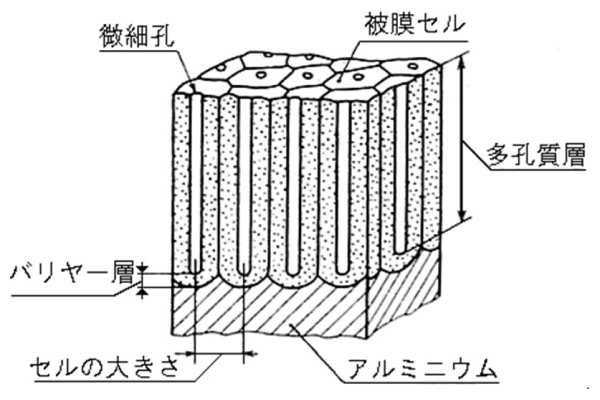
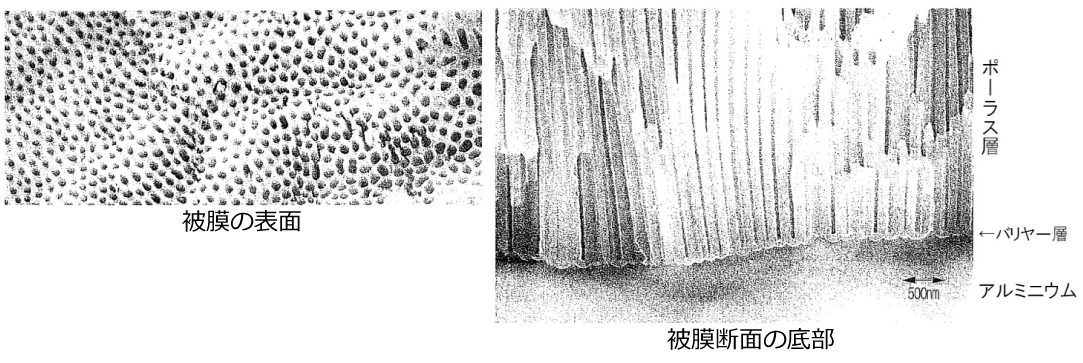
Anodized aluminum is characterized by hexagonal coating cells, with micropores forming from the aluminum surface. These pores are referred to as porous structures, and a "barrier layer" forms around them. A porous layer then grows and extends outward. The thickness of a standard anodized coating is approximately 10 μm.
Magnified view of the anodized coating
As shown in the magnified view, the surface contains numerous pores. The walls surrounding the pores at the base of the fractured coating surface are referred to as the barrier layer.
Formation process of the anodized coating
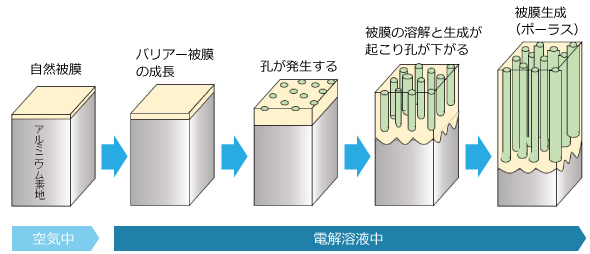
- Aluminum forms a protective film when exposed to air. The reason one-yen coins do not corrode is due to the formation of this natural film.
- When the formation of an anodized coating begins in an electrolytic solution, a barrier layer grows first.
- The film grows further, and pores form.
- Dissolution and formation of the coating occur, and the pores elongate.
- An anodized coating is formed.
Anodized aluminum dyeing process
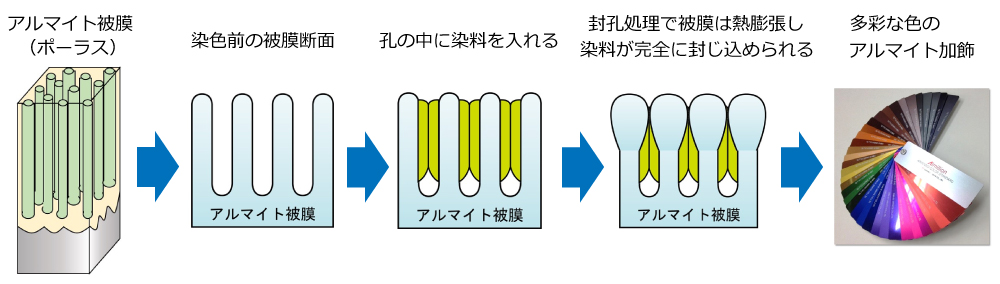
The pores in the coating remain open, allowing dye to be introduced into them. Once the dye is inside, a sealing process causes the coating to expand and seal the openings, effectively trapping the dye within the pores. This sealing process involves closing the open pores—after the anodized coating has been formed—using methods such as boiling or hot steam. Since the anodized coating itself is colorless and transparent, the color of the dye appears vivid and distinct. Using this technology, we can achieve vivid color reproduction that other companies cannot match.
Semi-hard anodizing(Improved sliding durability)
Anodizing processes include standard, semi-hard, and hard anodizing. The semi-hard and hard methods increase the aluminum's surface hardness and improve wear resistance. However, hardening the surface generally presents challenges regarding color reproduction when the finish is intended for decorative purposes.
Our semi-hard anodized finish offers superior surface hardness and wear resistance compared to standard anodizing—key characteristics of the semi-hard type. At the same time, thanks to our proprietary processing conditions, it achieves vivid color reproduction that other companies cannot match.
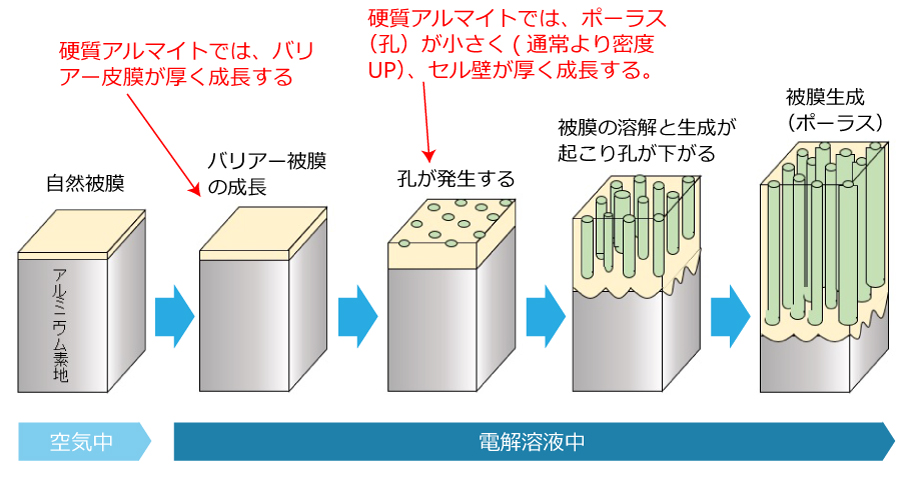
Illustration of an anodized coating
Anodized Coating Comparison
| Process | Typical film thickness | Hardness | Comparison(Iron Hv400) |
|---|---|---|---|
| Standard anodizing | 10~15μm | Hv200 | Softer than iron |
| Semi-hard anodizing | 20~40μm | Hv300~400 | Color anodizing comparable to iron |
| Hard-coat anodizing | 50μm以上 | around Hv400 | Harder than iron, colored anodizing is not possible |
Samples
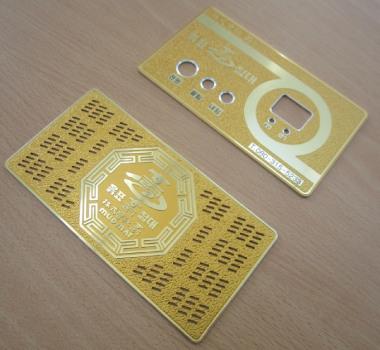
Thermometer panel
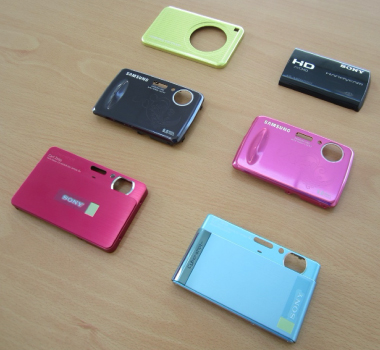
Digital camera case
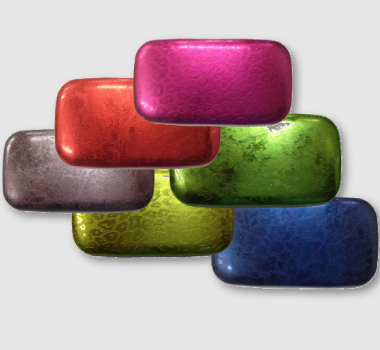
Soap Box
Almillion Characteristics of semi-hard anodizing
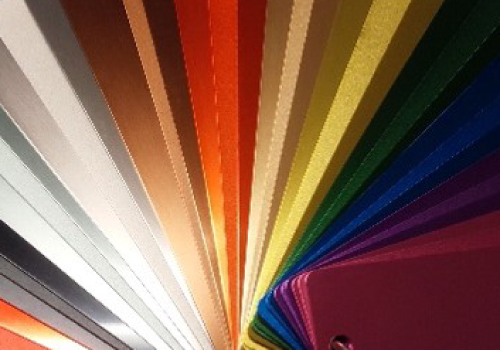
- The barrier layer is thicker than usual.
Wear resistance - The pores are small and the cell walls are thick.
It has excellent surface hardness. - Colored anodizing
The hard type generally comes in gray, but other colors are also available.